
Cigars

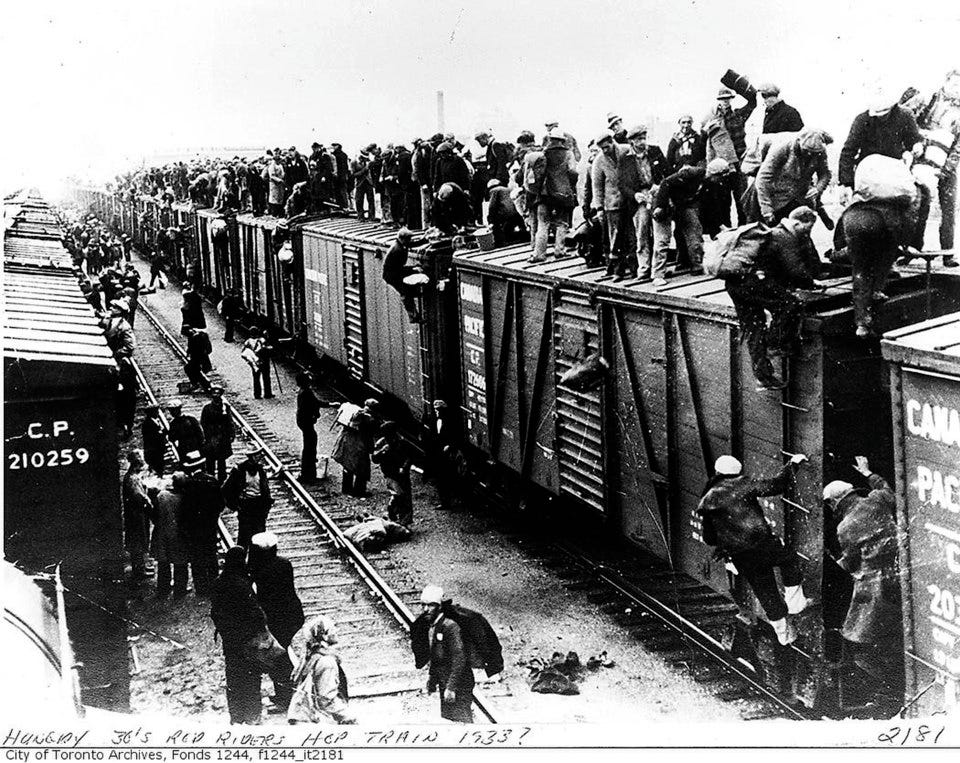
Unemployed men hop train. Circa 1933
It was deep summer. The leaves were still green on the dusty aspen in the backyard, but the color was of a deep, tired kind; fall was coming. An owl hooted and mosquito’s buzzed around the propane fire-pit where lay an assortment of simple pleasures of the type regulated by the ATF. The yard was surrounded by a diverse array of fencing spliced into a more or less regular barrier. A two story house lay to the north, the east had a decrepit alley garage that loomed two stories tall, the south a backyard from which the smell of skunked smoke constantly emanated, and the west was the house to which its occupants had the legal right of the small plot. Off to the side of the patio a grill let out a small amount of smoke indicating its recent use. With a gentle breeze, the smoke joined with that of pipe tobacco and cigar.
A blaze of yellow light came from the fire-pit’s otherwise blue flame.
“I can’t get this pipe to work,” Cole said, talking around the stem as he brought the flaming stick up to the bowl. “Don’t know why I had to break my old one.”
“You could always smoke a cigar,” Silas said, waving his own exhaled smoke away from his face; a peculiar habit of his.
Cole ignored this advice and concentrated on his pipe. Silence resumed, broken only by the distant roar and splutter of ATV being driven around the neighborhood. Even the highway a block away lay still.
A train horn sounded in the south. It signaled the railroad crossing a town away.
Cole set down his pipe with exasperation. He leaned back and retrieved a plastic tin from the window-ledge behind him. “I’ll just do Zyn instead.”
“I’ve got an extra cigar.” Silas said, holding up a plastic bag emblazoned with a logo that proudly proclaimed the word Cigarama.
“Thanks.” Cole replied. “But I’m fine. This is quicker.” He stuffed the pillow into his upper lip and took some beer. The train horn sounded again, this time for the county road just outside of town.
“Coffee flavored?” Silas picked up the tin.
“Thought I’d try it, but it doesn’t bite and it tastes like a scented candle.”
The train came at last, loud and clear as it signaled in town. The sound of a thousand wheels came upon them. Cole sprang up. “It’s not fair,” he said, straining himself to peer over the fence as if he could catch a glimpse of the freight.
Silas looked up at him, a bottle in hand, lit by the fading sun against the darkened east. He waited.
“It’s not fair.” Cole repeated, almost petulant. “Have you read about the great depression?”
“Yeah?”
“I used to read about the hobos,” Cole replied. “They would just hop on a train and go off to a new part of the country. I wanted to do that once.”
He sighed and sat down.
“But now there’s nowhere to go. Everything’s the same. The same McDonalds, the same Walmart, the same stop lights that lead to the same suburban neighborhoods. From Washington to California its all one monolith of sameness.”
“It’s not so bad to stay in one place; most people in history have done that.”
“If there is a pub, a wife, a field, a priest and a king lurking around, it isn’t. Instead we get a gas station, fast food, the liquor section of the grocery store, a gym full of strangers and a job worked under florescent lights with a woman as boss. Then to relax, endless scrolling on a phone filled with trash. Sundays we get a church stripped of art, a priest who is forced to say Mass in a friendly cheerful tone, altar girls, and woman who read the words of God and give us Christ instead of the priest.”
Silas remained silent.
“I know, I know, we’re lucky.” Cole sighed. “After all we don’t have to put up with half of that. We get to drive only a half-hour to hear the TLM... but perhaps we should be able to walk, to drink with the priest and storm the rectory in an emergency. Then and again, who wants to live in a cardboard apartment and trip over drug addicts?”
The sun slowly disappeared as the ash on Silas’s cigar grew longer. The shadow from the shed lurking in the corner touched the opposite fence and then dissolved into dusk.
“Sorry,” Cole said, suddenly. “I suppose it’s that way as a sort of penance.”
Silas looked down. “Perhaps, but it ought not have touched the Church.”
“Or the women. They suffer too.”
Silas nodded silently. After a bit he said, “I’ve got work tomorrow.”
“I should get to bed,” Cole replied.
“Goodnight.”
Cole nodded back. “Goodnight.” He leaned over and shut off the gas to the artificial fire-pit. He reached into his pocket and fingered his rosary. It would help him fall asleep.
Charles Gray